
Ice sheet change is expected to be a "slow" climate feedback. How rapidly ice sheets can disintegrate is one of the most uncertain and imporant climate issues. The dominant physical process causing ice sheet disintegration may be absorption of heat by the ocean (due to an increasing greenhouse effect), resulting melting of ice shelves, and thus an increased rate of discharge of ice from the ice sheet to the ocean. Once this process gets well underway, it may be difficult to prevent accelerating ice sheet disintegration under its own impetus.
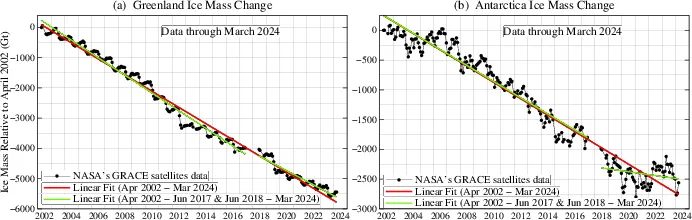
Data through March 2024. Figure in PDF (last modified 2024/07/02)
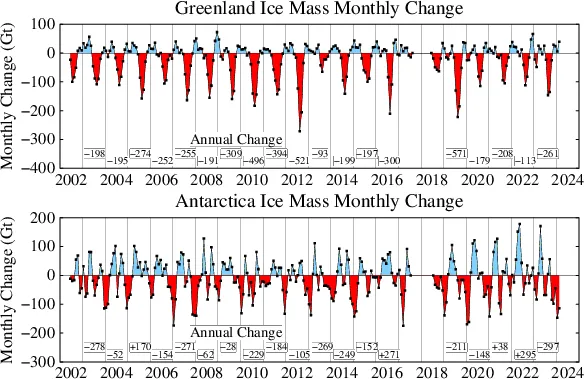
Data through February 2024 used. Figure in PDF (last modified 2024/05/24)
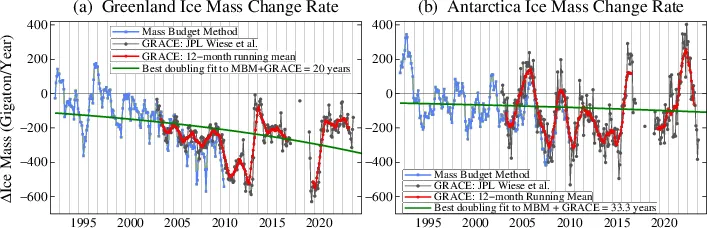
Data through February 2024. Figure in PDF. (last modified 2024/05/23)
The figures above show the rate of mass loss from the Greenland and Antarctic ice sheets, based on updates of Rignot et al. (2011) and Wiese, et al. (2019), and NASA Global Climate Change: Vital Signs of the Planet web page (Data through May 2022).
Approximate data read off from Rignot et al. (2019) of Fig.3A Antarctica and best doubling fit for 1979-2014 (end of the year).
References
E. Rignot et al. (2011) Acceleration of the contribution of the Greenland and Antarctic ice sheets to sea leve rise, GRL, 38, L05503 (5 pp.)
E. Rignot et al. (2019) Four decades of Antarctic Ice Sheet mass balance from 1979-2017, PNAS, doi:10.1073/pnas.1812883116.
Wiese, D. N., D.-N. Yuan, C. Boening, F. W. Landerer, and M. M. Watkins (2019) JPL GRACE and GRACE-FO Mascon Ocean, Ice, and Hydrology Equivalent Water Height RL06M CRI Filtered Version 2.0, Ver. 2.0, PO.DAAC, CA, USA. Dataset accessed [2021-03-17] at http://dx.doi.org/10.5067/TEMSC-3MJ62.
Our Essay
"Update of Greenlnad Ice Sheet Mass Loss: Exponential?" (2012/12/26)
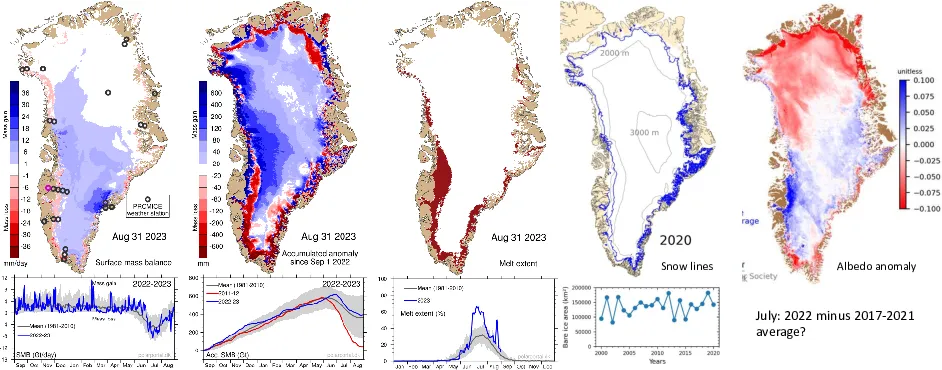
in PDF (last modified 2023/09/01)
Data source: Polar Portal: Surface Conditions
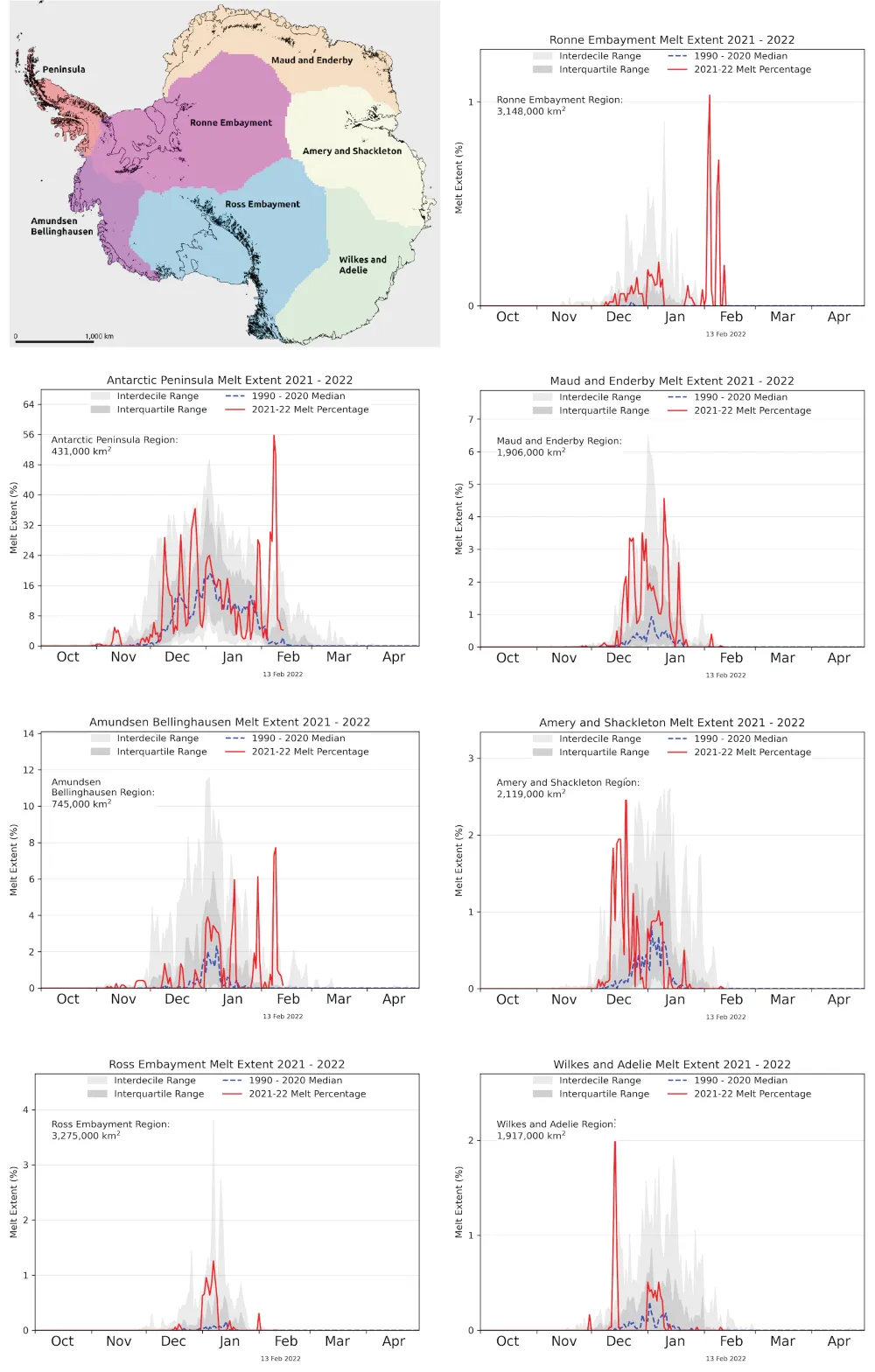
Figure 1b. These graphs show regional daily melt extent for seven Antarctic regions. As shown in Figure 1a, surface melting is limited to near-coastal areas everywhere except the Antarctic Peninsula this year. Credit: L. Lopez, NSIDC, M. MacFerrin, CIRES and T. Mote, University of Georgia